
Why I'm weirdly obsessed with this 'Mandalorian and Grogu' promo video
There’s a new Star Wars movie – The Mandalorian and Grogu – coming out in under a week, and you’ve no doubt seen countless ads for it by this point. Trailers, teasers, billboards on buses. But there’s one bit of promo for the movie that I’ve become weirdly obsessed with. At first glance, it’s pretty innocuous, and clocks in under 7 minutes long. It only has 62,000 views! But it accidentally ends up saying more about the current state of Star Wars and about big-budget moviemaking than you might think.
I happened across the video on YouTube, nestled among the others in my recommendations queue, posted on the official Star Wars channel. On the surface, it’s intended to be a fun little segment featuring the director, Jon Favreau, and his buddy Roy Choi, the celebrity chef. They’ve worked together for years, going back to when Favreau made the comedy-travelogue Chef, as an artistic palate cleanser after helming the first two Iron Man movies. Since then, Favreau and Choi made a whole cooking show for Netflix that ran for 25 episodes.
The premise of the Star Wars video is that Favreau and Choi are going to recreate a street food dish seen in the Mandalorian movie. It’s a scene glimpsed in the trailer, when the Mandalorian wants some information and questions a four-armed alien food vendor voiced by none other than Martin Scorsese. The vendor makes a sandwich for his guests, consisting of bread cooked in a taiyaki-style mould, filled with a griddled slice of spam-like meatloaf and topped with Hollandaise sauce from a hairy monster egg, along with blue onions (because would it be Star Wars if some food item wasn’t blue?). Meanwhile, in the YouTube video, Favreau and Choi want to demonstrate how the sandwich would be made in the movie universe, and how you can use simpler ingredients to make one at home. Simple concept for a scene, simple concept for a promo video, right?
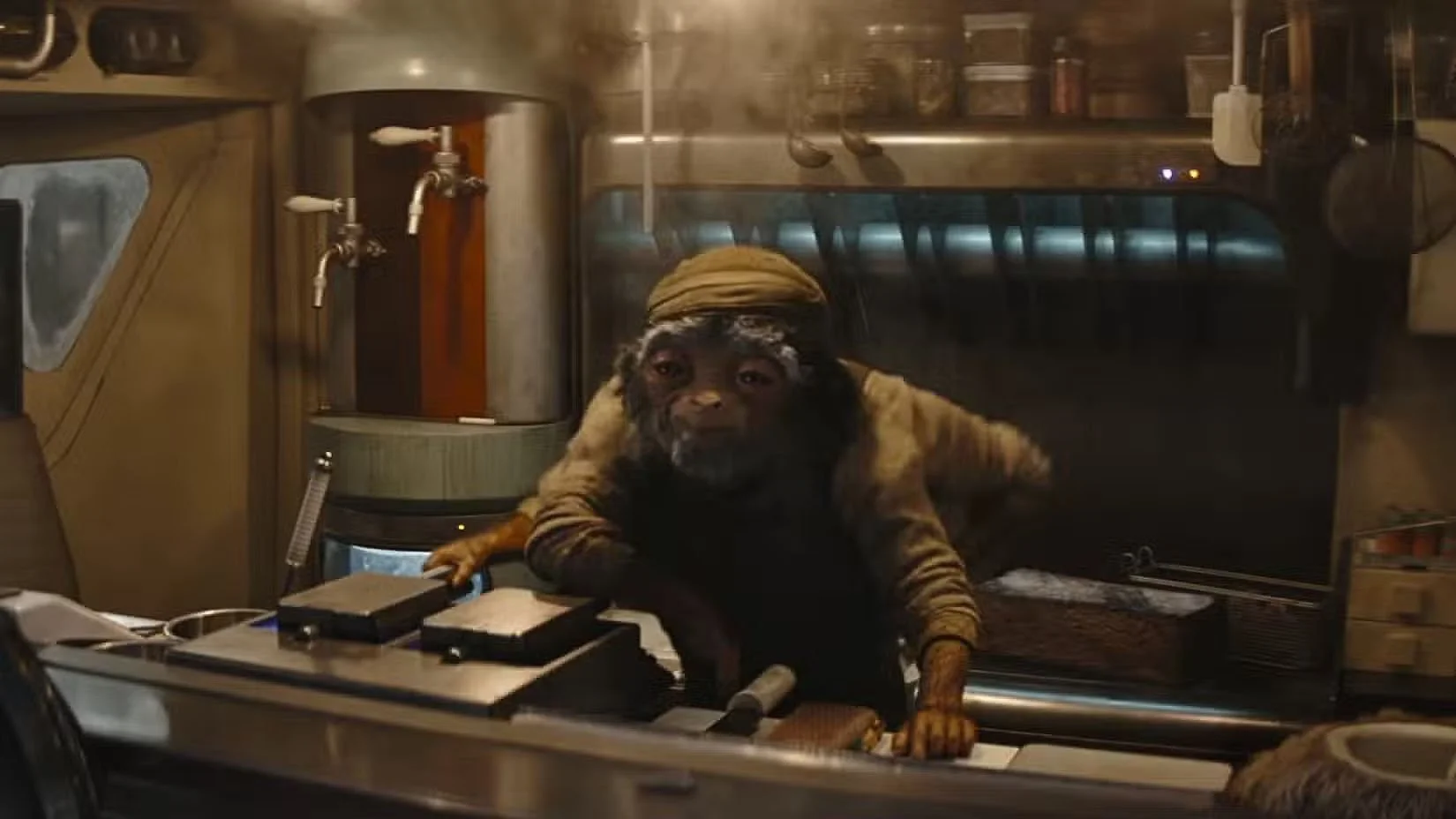
The four-armed food vendor voiced by Martin Scorsese.
The first weird thing I noticed about the video is how it’s edited. The flow of the action jumps around, skipping preparation steps and not explaining very much about the ingredients. It feels like a much longer segment cut down for…reasons? Considering this video is posted to YouTube, there doesn’t seem to be an explanation for the truncated editing. It’s also too long to have been intended for a platform like TikTok. What’s stranger is that both Favreau and Choi are experts in making cooking-related entertainment — it’s been at the core of their professional collaboration for over a decade! Both of them have even appeared as guests on other YouTube cooking shows, like Binging with Babish. The setup for this video even has all the usual trappings of a cooking video: prep tables facing the camera, an overhead camera to capture top-down shots of the food. Someone on this set knew what they were doing.
Amongst the disjointed editing, Favreau explains that his props department made real-life metal moulds that can actually cook the sandwich bread, even though the character using them is a digital creation. Hell, they built a whole food cart for the character, partially to act as a set for Pedro Pascal’s Mandalorian character to interact with alongside the Grogu puppet. That’s all well and good, but why did they need functional metal equipment built? Similarly, the props team built another hairy egg that Favreau shows off, and I have to believe the expense of these items wasn’t just for a YouTube video that a tiny fraction of the movie’s audience will see. I know that VFX artists like to take reference from physical objects to improve the realism of their shots, but this seems excessive. Surely the good people working for Lucasfilm have enough experience rendering fictional objects that they don’t need this kind of granularity in the set design?
That’s when Favreau briefly mentions the existence of these practical props as a reason on its own to see and appreciate the movie. He seems to be gesturing towards the constant drumbeat of comments about practical vs. digital effects on social media. Every day, legions of toxic fans determine a movie’s relative quality based on the extent of the post-production work. Marketing materials for other movies have even tried to erase the existence of CGI from discussion of a movie, like when the people behind Project Hail Mary claimed that “no green screen” was used during the production, when the reality was they simply used other digital techniques that better fit the look the filmmakers were going for. It’s utterly bizarre that certain people in the movie business have developed such a defensive posture about techniques that are essential to create the worlds they’re depicting. If I’m right, Favreau’s comment is a deeply cynical viewpoint on practical effects; in his view, they’re partially there to improve the believability of the visuals, but they’re also there to be bragged about and keep the fans at bay.
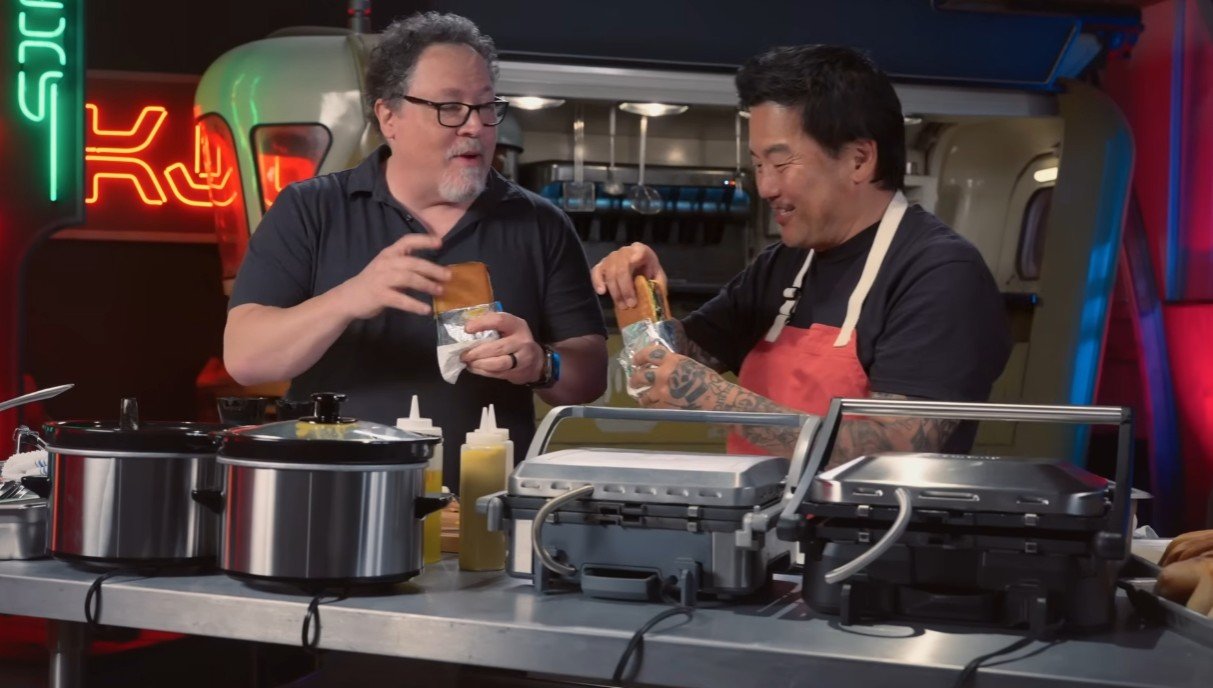
Mmm, content sandwiches
You also have to wonder about Roy Choi’s presence on the set. Admittedly, I haven’t seen the final film yet, but my guess is that the scene with the Scorsese-voiced alien doesn’t take up a lot of screen time. How does it serve the film to hire a celebrity chef to develop a sandwich recipe that might be glimpsed in a handful of shots? Are Star Wars fans meant to be wowed by the pedigree that comes with seeing a chef of Choi’s reputation contributing to a story set in a completely different galaxy? It almost begins to feel like Favreau’s padding the budget of the Mandalorian movie, hiring his buddy as a consultant so he can spread around those infinite Disney dollars, like some kind of car dealer hiding pointless add-ons in the contract for a new car purchase.
It makes you wonder how often this happens on other sets. There are obviously stories of the luxurious trailers and special catering companies that are ordered for the top-line talent on Marvel movies. Beyond food, film budgets in the hundreds of millions of dollars are perfect vehicles to hide some truly irresponsible spending. It’s amazing what people will spend money on under the auspices of “improving the final product”, only to find later that the whole thing needs to be replaced in post to correct an issue that no one foresaw on set. Meanwhile, in the independent film industry, filmmakers are starving for financing as studios and distributors look for sure bets based on intellectual property, instead of risky original stories.
Anyways, when The Mandalorian and Grogu does hit theatres in a few days’ time, you can rest easy knowing that not only did they cast a filmmaking legend to voice a random alien for a short scene, they also probably spent thousands of dollars building props that may never be directly seen on screen. I hope that desire to ground the film in such realism makes it easier to believe that Pedro Pascal fought a distressingly muscular slug.